


Sometimes when you’re searching, you’re not just looking for one specific result, you may be looking for a list to start a series of searches. For example, if you search for [greek philosophers], many search results mention well known philosophers like Plato or Aristotle. Typically, searches like these are the beginning of a research task, where you follow up by searching to learn more about each item in the list, in this case each philosopher.
Starting today, for many of your list seeking searches, you’ll see a collection of the top referenced items from the topic of your search.
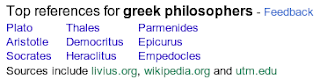
If you click one of these links, the collection of links moves to the top of the results page, and results for the philosopher you clicked are shown below. Since the top references block stays anchored on top of your search results, it's easy to explore and learn about each of the philosophers. You can see top references for a variety of topics -- try out [american authors], [seattle neighborhoods], [famous basketball players], or [cruciferous vegetables].
Sometimes, a list of related searches is helpful even if you don't ask for the list directly. If you search for [van gogh], you may also be interested in learning more about his paintings. For many searches for artists, you can now see a list of famous paintings at the bottom of the search results page.

Similarly, search for a movie like [inception] or TV show like [30 rock], and you'll see a list of starring cast members. You can also see these sorts of results for other types of searches -- for example [u2], [stephen king], or [tom hanks]. These related searches currently appear in English only on google.com.
To better understand and answer your searches for a list, we use a variety of signals to assess what the web collectively thinks are the most significant items associated with your search keywords. Since Plato is discussed so frequently in pages about Greek philosophers, our algorithms can infer that he is an important Greek philosopher. Much of this work is based on common search patterns and Google Squared technology which we introduced into Google Labs in June 2009.
This improvement to related searches reflects our continued efforts to help our algorithms better understand content on the web in the complex ways that humans do, and use that understanding to help you as you search. We see a lot more potential in this exciting area of research and we're looking forward to introducing more improvements in the future.
Starting today, for many of your list seeking searches, you’ll see a collection of the top referenced items from the topic of your search.

If you click one of these links, the collection of links moves to the top of the results page, and results for the philosopher you clicked are shown below. Since the top references block stays anchored on top of your search results, it's easy to explore and learn about each of the philosophers. You can see top references for a variety of topics -- try out [american authors], [seattle neighborhoods], [famous basketball players], or [cruciferous vegetables].
Sometimes, a list of related searches is helpful even if you don't ask for the list directly. If you search for [van gogh], you may also be interested in learning more about his paintings. For many searches for artists, you can now see a list of famous paintings at the bottom of the search results page.

Similarly, search for a movie like [inception] or TV show like [30 rock], and you'll see a list of starring cast members. You can also see these sorts of results for other types of searches -- for example [u2], [stephen king], or [tom hanks]. These related searches currently appear in English only on google.com.
To better understand and answer your searches for a list, we use a variety of signals to assess what the web collectively thinks are the most significant items associated with your search keywords. Since Plato is discussed so frequently in pages about Greek philosophers, our algorithms can infer that he is an important Greek philosopher. Much of this work is based on common search patterns and Google Squared technology which we introduced into Google Labs in June 2009.
This improvement to related searches reflects our continued efforts to help our algorithms better understand content on the web in the complex ways that humans do, and use that understanding to help you as you search. We see a lot more potential in this exciting area of research and we're looking forward to introducing more improvements in the future.


0 comments:
Post a Comment